
Gone's mission is to orchestrate the world's most efficient circular supply chain. In 2026, we filed our first recycling license report with the City of Seattle, accounting for every ton of material we could trace back to items picked up from Seattle in 2025.
Every year, businesses that handle recyclable and reusable materials in Seattle are required to file a report with the city as part of the recycling license process. This past year was our first time doing it.
We’ve been picking up items with useful life remaining from Seattle since 2024; however, tracking every item received and estimating its weight for review, to formalize that relationship with the city is a more rigorous step.
Here's what 2025 looked like:
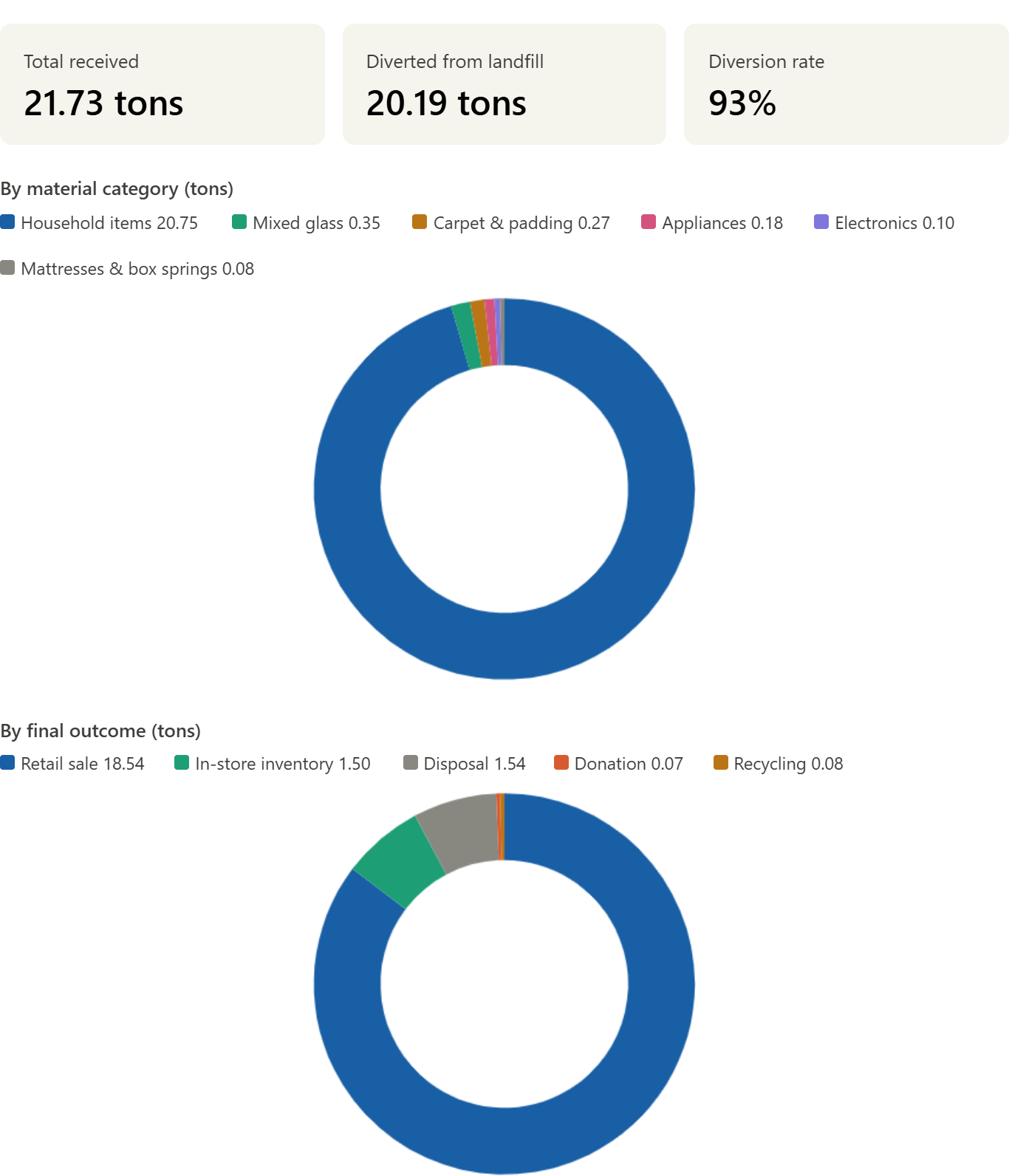
Overall, Gone received 21.73 tons of material we could reasonably trace back by zip code to neighborhoods in Seattle — household goods, appliances, electronics, carpet, mattresses, and glass. Items were matched to a category based on their assessed dominant material from product titles and descriptions. Each item’s weight is estimated based on item type and size from publicly available datasets, and then aggregated by category.
Of that total, 20.19 tons - about 93% - was diverted from landfill through retail resale, donation to nonprofit partners, or recycling. The remaining 1.54 tons, items with no viable recovery path went to the Renton Transfer Station.
- Household goods made up nearly 95% of volume (20.75 tons). The majority went directly to buyers through our retail platform, while a small proportion remain held in our store inventory or are donated. Items that couldn't find a path went to disposal, the majority of the 7% of items with no useful life remaining.
- Mixed glass (0.35 tons) and carpet and carpet padding (0.27 tons) went primarily to retail buyers. Appliances (0.18 tons) and electronics (0.10 tons) went entirely to retail or are held in our store inventory.
- Mattresses and box springs (0.08 tons) were split evenly between retail sale and disposal. They're one of the harder categories in the reuse economy: bulky, condition-sensitive, and a tougher sell. We're continuing to explore better recovery paths here.
The most effective waste diversion happens before materials ever reach a transfer station. We meet people in their homes, assess what has remaining useful life, and route every item to the best possible destination — retail, donation, or recycling — before it ever becomes part of the throughput problem.
We’re proud that 93% of the 21.73 tons received from Seattle were diverted from the landfill, and we will continue working to minimize the 7% gap.
Excited to file again next year, with even better numbers.